

(The kundalini was named Quetzalcoatl by the Toltecs and Kukulkan by the Mayas. A version of the image of Quetzalcoatl is on the Mexican national flag to this day. )
After this experience I lost all interest in a career and marriage and a “normal” life. I barely graduated the university and went to India seeking more understanding. There I met Chidghananda, a solitary old monk well-venerated in his order. He was regarded as a saint and I felt so honored that he took me into his close friendship and care. Sometimes I would accompany him with his evening meditations. He always heard the holy Om sound and it increased in his meditation. It was obvious that he regularly experienced ananda, divine bliss. He was truly one of the most loving human beings that I have ever met. My experiences had intensified near him at Ananda Nagar and it was clearly divine will that I had met such a teacher to guide me through these powerful processes.
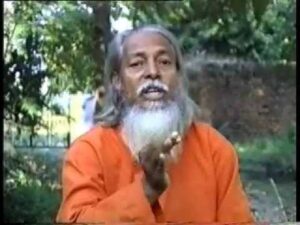
At the time I wanted to become a monk but Chidghananda himself told me that I was a bit of an oddity and would not fit in well with the monastic organization. He said that my spiritual work was coming to an end, and that I didn’t really need to do anything else with my life rather than meditate, live simply, and help others as much as I could. Although sharply criticized for his influence over me, he followed his conscience and spoke only the truth to me. Although very confused as to what to do with my life once the ideal of being a monk was fading, I was aided by a dream in which Anandmurti commanded me not to worry about becoming a monk, but just to “see the world as a frame-less photo and wander through the night.” Anandamurti has always spoken to me through dreams in such an elevated, poetic fashion. Later, as a confirmation he told me in another vivid dream that “all that matters is to do dhyana dasha.” He used those Sanskrit words, one of which I knew of not until a friend looked it up in a Sanskrit dictionary. What Anandamurti said was “all that matters is to do service through meditation.” I was often unsure if in these dreams I communicated with the spirit of Anandamurti, or if Anandamurti had become a mere symbol in my consciousness that had penetrated my dreams. Either way, these dreams always made perfect sense to me and enlightened difficult situations. If they were my own projections, then they came from the deepest, most intuitive parts of me that have never let me down.
It was soon after that I met Chandranath and his wife, Ram Pari Devii. They were some of the first initiates and spiritual teachers, or acharyas, personally taught by Anandamurti in the 1950’s. They were undoubtedly the most spiritually elevated beings that I have ever met. The whole environment around them was bliss. Even their lifelong employees, like the cook and the gardener, had become highly developed yogis. Speaking with Chandranath removed any doubts I had about my meditation and he told me that the intensity would calm down with time. He gave me invaluable tips about the mystical subtleties of spiritual practice and left me with the deepest sensation of divine peace that I still feel each time I recall being in his presence. Both he and his wife were established in the practice of samadhi (experiential union with the Supreme Consciousness) and could enter into it at will. They were free, realized souls whose only reason to still be physically incarnated was to help others along the path. After meeting them I realized that more important than being a monk or householder was to simply try to be at one with the Supreme Consciousness at all times, as they were.
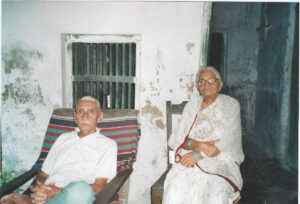
When I sat next to Chandranath and tried to listen to him speak of the Supreme Consciousness I could not understand a word he said. He took me into himself and there was only silence and a soft. white glow. I still try to recall that experience and become so still, forget even breathing, and there is still only silence and a soft, white glow.
People like Chandranath have set a practical example of how a realized yogi can live in the world. It seems miraculous, perhaps even absurd, that the human mind can unite with the Supreme Consciousness. We can truly say “I am This” from the most sincere and complete part of our beings. However, it seems even more miraculous the benevolent grace that emanates from such a realized being and their ability to transform others. He seemed to me a man so simple and pure and I never felt that he was asking anything from me; he only gave himself wholeheartedly to anybody seeking guidance. For a yogi who practices samadhi regularly, such a conscious and humane expression like Chandranath is the most natural and simple creation of the Supreme Consciousness. When the microcosmic mind dissolves into the Supreme Consciousness, there is really no ego, nor even I-feeling, that binds one to the relative plane. Many yogis leave their bodies after such experiences. Others, like Chandranath, mysteriously returned to the relative plane of earthly existence and continued to serve others. I think that when when one enters the breathless state of samadhi and dissolves completely into the Supreme Consciousness, then it is only this One that can breathe the breath back into this unified yogi. If it weren’t for people like Chandranath, his wife and Chidghananda, who really set such a practical ideal, then I probably would have thought that such beings existed only in the distant past, in legends, and that the modern world is no longer habitable for advanced yogis. In the most mystical and subtle ways, people like Chandranath leave an undying imprint on the people they affect, and thereby leave their mark on the collective consciousness of humanity as a whole.
